


7007 Islington Avenue, Unit 207, Woodbridge, ON L4L 1V8
When you hear scratching sounds in your walls or discover small droppings in your pantry, the first question that comes to mind is: what kind of rodent has invaded my home? Understanding whether you’re dealing with a mouse or rat infestation isn’t just about curiosity, it’s crucial for effective pest control and protecting your Canadian property from damage.
Mice vs rats may seem similar at first glance, but these rodents differ significantly in size, behavior, habitat preferences, and the level of threat they pose to your home. Misidentifying which species you’re dealing with can lead to ineffective control methods, wasted money, and prolonged infestations. In Canada, where both house mice and Norway rats are common invaders during our cold winters, knowing how to distinguish between these pests is essential for every homeowner.
This comprehensive guide will walk you through everything you need to identify rodents accurately, from physical characteristics and behavioral patterns to the telltale signs each species leaves behind. Whether you’re in Toronto, Vancouver, or rural Alberta, you’ll learn exactly what to look for and how to respond appropriately.
Understanding the Basic Size Difference
The most obvious distinction when comparing these two rodents is their body size, though this can sometimes be misleading when you’re dealing with young rats or fully grown mice.
Adult mice typically measure 5 to 10 centimeters in body length, not including their long, thin tails which add another 5 to 10 cm. They’re remarkably small and lightweight, usually weighing between 12 to 30 grams about the weight of a handful of coins. Their compact size allows them to squeeze through openings as small as a dime, making them incredibly adept at infiltrating Canadian homes through tiny cracks and gaps.
Rats, on the other hand, are substantially larger creatures. The Norway rat (also called the brown rat), which is the most common species found in Canadian homes, measures 18 to 25 cm in body length with an additional 15 to 20 cm tail. These rodents can weigh anywhere from 200 to 500 grams roughly the size of a small guinea pig. Their larger size means they need bigger entry points, but don’t let that reassure you; rats can still compress their bodies through openings as small as a quarter.
When you spot a rodent darting across your floor, size is often the first clue, but baby rats can sometimes be confused with adult mice. That’s why it’s important to look at other distinguishing features beyond just body dimensions.
Quick Identification Reference Table
| Feature | Mice | Rats |
| Body Length | 5-10 cm | 18-25 cm |
| Tail Length | 5-10 cm (thin, hairy) | 15-20 cm (thick, scaly) |
| Weight | 12-30 grams | 200-500 grams |
| Head Shape | Triangular, pointed snout | Blunt, broad head |
| Ears | Large, prominent, hairless | Small, thick, hairy |
| Eyes | Large, protruding | Small, proportionate |
| Droppings Size | 3-6 mm (pointed ends) | 12-18 mm (blunt ends) |
| Droppings/Day | 50-75 | 40-50 |
| Entry Gap Size | 6 mm (dime-sized) | 12-13 mm (quarter-sized) |
| Gnaw Mark Width | 1-2 mm | 3-4+ mm |
| Territorial Range | 3-9 meters | 30-45 meters |
| Behavior | Curious, bold | Cautious, neophobic |
| Nest Size | Grapefruit-sized | Football-sized or larger |
Physical Features That Set Them Apart
Beyond size, several physical characteristics can help you definitively identify which rodent species has taken up residence in your home.
Head and Facial Structure
Key differences to look for:
- Mice: Distinctly triangular head with pointed snout
- Mice: Large, prominent ears that appear oversized and nearly hairless
- Mice: Large, protruding eyes giving an alert expression
- Rats: Blunter, broader heads with less pointed snouts
- Rats: Smaller ears in proportion, thicker with noticeable hair coverage
- Rats: Small eyes relative to head size, robust facial structure
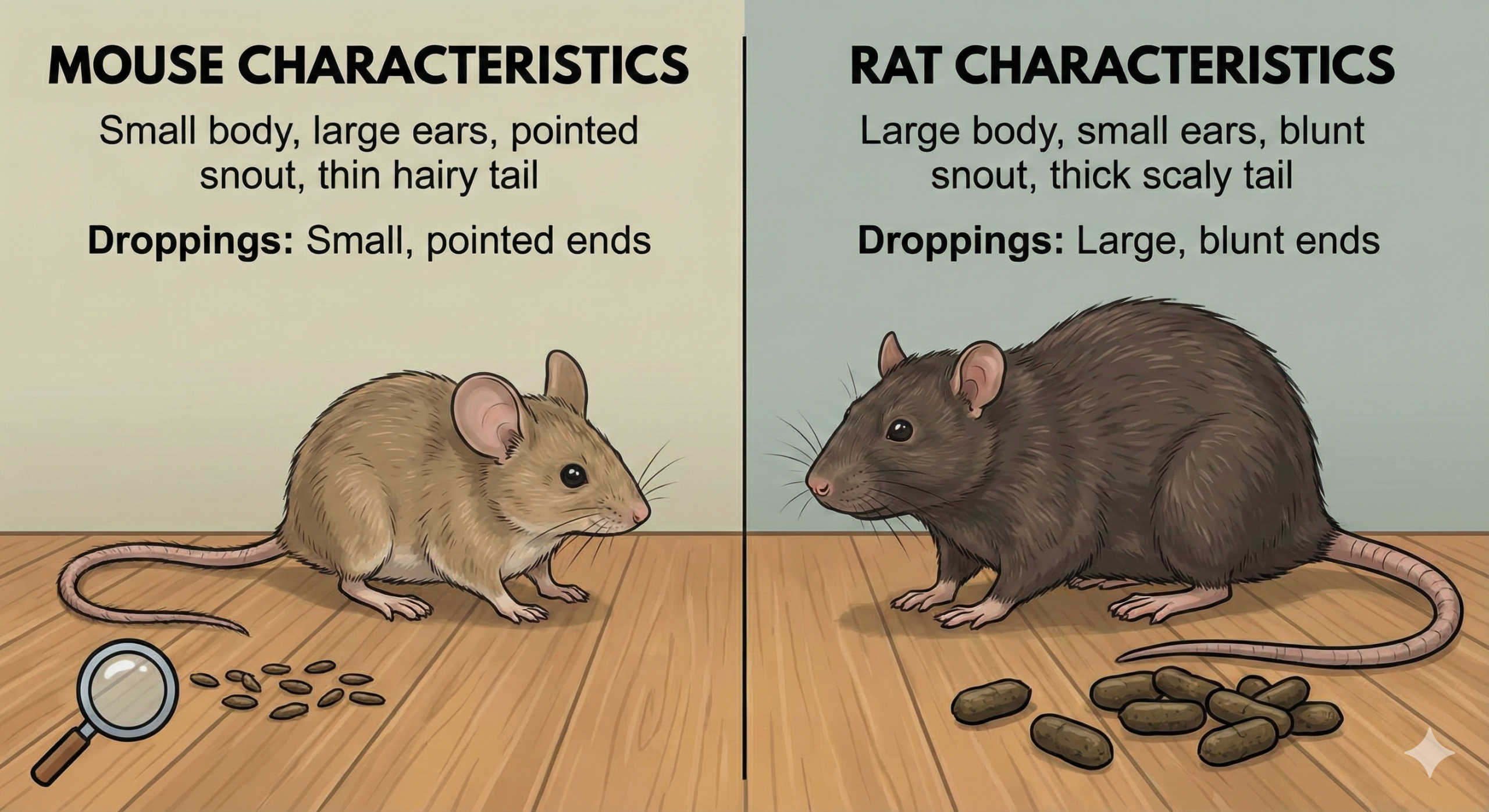
A mouse has a distinctly triangular head with a pointed snout and large, prominent ears that appear oversized relative to their head. Their ears are thin and nearly hairless, giving them an almost translucent appearance. The eyes of a mouse are large and somewhat protruding, giving them an alert, curious expression.
Rats have blunter, broader heads with a less pointed snout. Their ears are smaller in proportion to their head size and are thicker with more noticeable hair coverage. Norway rats, in particular, have small eyes relative to their head size and a more robust, stocky facial structure that makes them look less delicate than their smaller cousins.
Tail Characteristics
The tail is a key identifier, making it one of the most reliable markers for identification. Mouse tails are thin, long, and covered with a light layer of fine hair. The tail is typically as long as or slightly longer than their body and head combined, appearing whip-like and flexible.
Rat tails are thick, scaly, and sparsely haired, with a clearly segmented appearance that resembles a thick rope. A Norway rat’s tail is usually shorter than the combined length of its body and head. The tail feels thick and heavy, quite different from the delicate mouse tail.
Fur Color and Texture
Most house mice found in Canadian homes have light brown or dusty gray fur on their backs with lighter, cream-colored or white bellies. Their fur is soft and relatively smooth, giving them a sleek appearance.
Norway rats typically display coarse, shaggy brown or gray fur on their upper body with gray or off-white underbellies. Their fur looks more bristly and rough compared to the softer mouse coat. Some rats may appear reddish-brown, while others lean toward grayish-brown shades.
Behavioral Patterns and Habits
Understanding how these rodents behave differently can help you identify which species you’re dealing with, even if you haven’t seen the animal itself.
Activity Patterns
Both species are primarily nocturnal, but they exhibit different levels of boldness:
Mouse behavior:
- Naturally curious and less cautious
- Often venture into open spaces quickly
- Investigate new objects in their environment relatively fast
- May be spotted during evening hours where they feel secure
Rat behavior:
- Considerably more cautious and neophobic (afraid of new things)
- Avoid new objects, traps, or environmental changes for days or weeks
- Extremely intelligent, learn to avoid dangers
- More strictly nocturnal, they rarely venture out during daylight
- Only appear in daytime when the population is very large or food is scarce
Mice are naturally curious and less cautious creatures. They’ll often venture into open spaces and investigate new objects in their environment relatively quickly. You might spot mice during evening hours in homes where they feel secure.
Rats are considerably more cautious and neophobic, meaning they’re afraid of new things. A rat will often avoid new objects, traps, or changes in their environment for several days or even weeks. They’re extremely intelligent and can learn to avoid dangers, making them more challenging to control. Rats are also more nocturnal than mice and rarely venture out during daylight unless the population is very large or food is scarce.
Social Structure
Mice are social animals that live in family groups but can be relatively independent. A female mouse can establish her own territory and nest separately if conditions allow.
Rats are highly social and live in hierarchical colonies with dominant males and females. They exhibit complex social behaviors, communicate through ultrasonic vocalizations, and follow established pathways within their territory. This social nature means that where you find one rat, there are likely many more hiding nearby.
Territorial Range
Mice have relatively small territories and tend to stay within 3 to 9 meters of their nesting area. They’re creatures of habit and will use the same pathways repeatedly, though they may venture further if food is scarce.
Rats have much larger territories and will travel up to 30 to 45 meters from their nest in search of food and water. This extended range means a rat infestation can affect a much larger area of your property, and they may be nesting far from where you see signs of activity.
Identifying Droppings and Other Signs
Often, you’ll know you have a rodent problem before you ever see the animal itself. Learning to recognize and differentiate between mouse and rat droppings is crucial for proper identification.
Droppings Characteristics
Mouse droppings:
- Size: 3-6 mm in length
- Shape: Pointed ends (rice-like)
- Color: Black or dark brown
- Quantity: 50-75 per day from a single mouse
- Distribution: Scattered randomly throughout areas they frequent
Rat droppings:
- Size: 12-18 mm in length
- Shape: Blunt ends (jellybean-like)
- Color: Dark brown to black (shiny when fresh, dry and gray with age)
- Quantity: 40-50 per day from a single rat
- Distribution: Concentrated along regular pathways (not randomly scattered)
Mouse droppings are small, typically 3 to 6 millimeters in length, with pointed ends. They resemble dark grains of rice and are usually black or dark brown. You might find 50 to 75 droppings per day from a single mouse, scattered randomly throughout the areas they frequent.
Rat droppings are significantly larger, measuring 12 to 18 millimeters in length with blunt ends, resembling dark jellybeans or large coffee beans. They’re usually dark brown to black and have a shiny, wet appearance when fresh, becoming dry and gray with age. A single rat can produce 40 to 50 droppings daily, but because rats are more cautious, you’ll typically find them concentrated along regular pathways rather than scattered randomly.
Gnaw Marks and Damage
Both species need to gnaw constantly to keep their continuously growing teeth manageable, but the damage they create differs noticeably.
Mice leave tiny gnaw marks, approximately 1 to 2 millimeters wide, with a rough, scratched appearance. You might find these on baseboards, food packaging, cardboard, or plastic containers. The gnawed edges appear more scraped than cleanly cut.
Rats create much larger gnaw marks, typically 3 to 4 millimeters wide or more, with a rougher, more aggressive appearance. They can gnaw through wood, plastic, aluminum siding, and even soft concrete. The gnaw marks appear as rough, jagged grooves and are often found on structural elements like joists, studs, and pipes.
Track and Rub Marks
Mice leave tiny footprints when traveling through dusty areas, with front feet showing four toes and back feet showing five. Because they’re so light, they don’t always leave visible tracks unless conditions are ideal.
Rats leave larger, more noticeable footprints, and their heavier bodies create drag marks from their tails. More distinctively, rats create dark, greasy rub marks along walls, pipes, and beams where their oily fur repeatedly brushes against surfaces as they travel their regular routes. These smudge marks are one of the most reliable signs of rat activity.
Nesting Materials and Locations
Mice make comfy nests from soft stuff like paper shreds, fabric scraps, and insulation materials. They prefer concealed locations close to food sources, such as inside wall voids, under appliances, in stored boxes, or even inside furniture. Mouse nests are relatively small, roughly the size of a grapefruit.
Rats construct larger, more elaborate nests using similar materials but on a bigger scale. Norway rats typically nest in burrows outdoors near building foundations or in basements, crawl spaces, and lower levels of structures. Their nests can be the size of a football or larger and are often hidden in secluded areas with minimal disturbance.
Understanding Entry Points and Vulnerabilities
Knowing how these rodents gain access to your home helps with both identification and prevention.
Common entry points for mice:
- Gaps around pipes and utility lines
- Cracks in foundations (6mm+ openings)
- Poorly sealed windows and doors
- Gaps under siding
- Openings around vents and chimneys
- Can squeeze through openings as small as a pencil diameter
Common entry points for rats:
- Floor drains
- Damaged roof vents
- Gaps in foundations (12-13mm+ openings)
- Openings where utilities enter the building
- Broken basement windows
- Sewer lines and broken toilet connections (excellent swimmers)
- Can enlarge smaller gaps by gnawing
Mice exploit the tiniest vulnerabilities in your home’s exterior. They can squeeze through openings as small as 6 millimeters, about the diameter of a pencil. Common entry points include gaps around pipes and utility lines, cracks in foundations, poorly sealed windows and doors, gaps under siding, and openings around vents and chimneys. In Canadian homes, mice often enter when seeking warmth as temperatures drop in the fall.
Rats require slightly larger openings, around 12 to 13 millimeters, but are strong enough to enlarge smaller gaps by gnawing. They commonly enter through floor drains, damaged roof vents, gaps in foundations, openings where utilities enter the building, and broken basement windows. Norway rats are excellent swimmers and can enter through sewer lines and broken toilet connections, a particular concern in older Canadian homes.
Health Risks and Concerns for Canadian Homeowners
Both rodent species pose significant health risks, though the level of danger differs somewhat between them.
Diseases mice can transmit:
- Hantavirus (rare in Canada)
- Salmonellosis
- Leptospirosis
- Lymphocytic choriomeningitis
- Contaminate food surfaces with urine and droppings
- Spread bacteria throughout your home
- Mouse allergens can trigger asthma attacks in children
Diseases and risks rats pose:
- Similar diseases but in higher concentrations
- More dangerous and common rat bites
- Larger droppings and urine output = more contamination
- More likely to access food preparation areas
- Host parasites (fleas, mites, ticks)
Mice can carry and transmit several diseases, including Hantavirus (though rare in Canada), Salmonellosis, Leptospirosis, and Lymphocytic choriomeningitis. They contaminate food surfaces with their urine and droppings, and their constant movement spreads bacteria throughout your home. Mouse allergens in urine and dander can trigger asthma attacks, particularly in children.
Rats pose even greater health risks due to their larger size, more extensive territories, and habits. They’re associated with similar diseases but in more concerning concentrations. Rat bites are more dangerous and common than mouse bites, especially if you accidentally corner one. Their larger droppings and urine output mean more extensive contamination, and they’re more likely to access areas where you prepare food.
Both species host parasites like fleas, mites, and ticks that can transfer to humans and pets, creating secondary infestation concerns in your home.
Why Quick Identification Matters
Correctly identifying whether you’re dealing with a mouse or rat infestation affects every aspect of your control strategy.
Treatment approaches differ significantly between species. Snap traps for mice need to be smaller and placed differently than rat traps. Bait stations require different formulations and placement strategies. The amount of bait needed, trap sensitivity, and even the timing of control efforts vary based on species.
Exclusion strategies must be tailored to each rodent’s size and behavior. Sealing a home against mice requires attention to much smaller gaps than rat-proofing does. However, rat prevention demands stronger materials since they can gnaw through barriers that would stop mice.
Cost and time investments change depending on which species you’re dealing with. Rat infestations typically require more extensive and expensive control measures due to their larger size, intelligence, and reproductive capacity. They’re also harder to eliminate completely because of their cautious nature and complex social structure.
Structural damage potential differs dramatically. While mice can chew wires and create fire hazards, rats can compromise structural integrity by gnawing through support beams, creating extensive burrow systems that undermine foundations, and damaging HVAC systems and plumbing.
Professional Inspection and Identification
While this guide provides comprehensive information for identification, sometimes professional expertise is necessary, especially in Canada where our climate creates unique pest pressure.
When to call a professional:
- Uncertain about the species
- Infestation appears widespread
- Found signs in multiple areas of your home
- DIY control efforts haven’t worked after 2-3 weeks
- Concerns about safely handling contaminated areas
- Dealing with a commercial property requiring documentation
Consider calling a licensed pest control professional when you’re uncertain about the species, the infestation appears widespread, you’ve found signs in multiple areas of your home, DIY control efforts haven’t worked after two to three weeks, you have concerns about safely handling contaminated areas, or you’re dealing with a commercial property that requires documentation.
Professional pest control technicians can accurately identify the species, locate all entry points and nesting areas, assess the infestation severity, develop comprehensive treatment plans, and implement exclusion strategies that prevent future invasions.
For Toronto-area homeowners, understanding local rodent behavior and seasonal patterns is essential for effective year-round protection. Explore comprehensive rodent control strategies tailored for Toronto homes that address the GTA’s unique urban pest challenges.
Seasonal Considerations in Canada
Canadian weather patterns significantly influence rodent behavior and identification priorities.
Fall (September-November):
- Peak season for infestations begins
- Both mice and rats actively seek entry as temperatures drop
- Most likely to notice initial signs
Winter (December-March):
- Rodents are fully established indoors
- Notice droppings, gnaw marks, sounds
- Populations grow in the warmth of your home
Spring (April-May):
- Increased activity as rodents breed prolifically
- More signs as populations expand
Summer (June-August):
- Reduced indoor activity as food is abundant outdoors
- Established infestations persist year-round
During fall (September through November), both mice and rats actively seek entry into homes as temperatures drop. This is peak season for infestations, and you’re most likely to notice initial signs during this period.
In winter (December through March), rodents are fully established indoors. This is when you might first notice droppings, gnaw marks, or hear sounds as populations grow in the warmth of your home.
Spring (April through May) sees increased activity as rodents breed prolifically. You may notice more signs as populations expand.
Summer (June through August) typically sees reduced indoor activity as food becomes abundant outdoors, though established infestations persist year-round.
Taking Action Based on Your Identification
Once you’ve correctly identified which rodent you’re dealing with, immediate action prevents the problem from escalating.
For mouse infestations:
- Eliminate food sources (sealed metal/glass containers)
- Clean up crumbs and spills immediately
- Secure garbage in rodent-proof containers
- Set multiple snap traps along walls (use peanut butter/chocolate as bait)
- Seal all openings larger than 6mm using steel wool and caulk
- Clean and sanitize affected areas (wear gloves and a mask)
For rat infestations:
Once you’ve identified a mouse infestation, swift action is critical. For detailed, step-by-step instructions on 12 proven mouse removal methods from snap traps to natural deterrents, explore our comprehensive elimination guide with prevention strategies that work.
- Use larger, more powerful snap traps or specialized rat traps
- Consider consulting professionals sooner due to the complexity of rat behavior
- Seal openings larger than 13mm with metal flashing, concrete, or hardware cloth
- Inspect the entire foundation and lower level
- Prepare for a longer control period due to the rats’ cautious nature
- All mouse prevention steps apply (but more intensive)
For mouse infestations, start by eliminating food sources by storing all food in sealed metal or glass containers, cleaning up crumbs and spills immediately, and securing garbage in rodent-proof containers. Set multiple snap traps along walls where you’ve seen signs, using peanut butter or chocolate as bait. Seal all openings larger than 6 millimeters using steel wool and caulk. Clean and sanitize affected areas wearing gloves and a mask.
For rat infestations, the approach is similar but more intensive. Use larger, more powerful snap traps or specialized rat traps. Consider consulting professionals sooner rather than later due to the complexity of rat behavior. Seal openings larger than 13 millimeters with metal flashing, concrete, or heavy-grade hardware cloth. Inspect and secure potential entry points around your entire foundation and lower level. Be prepared for a longer control period due to the rats’ cautious nature.
Conclusion
Accurately distinguishing between mice vs rats is the critical first step in protecting your Canadian home from rodent damage and health hazards. While both species share some similarities, understanding their key differences from body size and physical features to droppings, behavior patterns, and nesting preferences empowers you to respond appropriately and effectively.
Remember that mice are smaller, more curious creatures with thin tails and tiny droppings, while rats are larger, more cautious animals with thick, scaly tails and substantial droppings. The damage they create, the health risks they pose, and the control methods that work best all depend on correct species identification.
Don’t wait for a minor problem to become a major infestation. Whether you’ve spotted droppings in your pantry, heard scratching in your walls, or discovered gnaw marks on your baseboards, identifying which rodent species you’re dealing with allows you to implement targeted solutions quickly. When in doubt, consulting with a licensed pest control professional ensures you get expert identification and effective treatment tailored to your specific situation.
Your home should be a safe, comfortable sanctuary not a habitat for unwanted rodents. With the knowledge from this guide, you’re equipped to identify the intruder and take decisive action to reclaim your space.
People also ask
1. What’s the difference between mice and rats?
Mice are much smaller, lighter, and have long, thin, slightly hairy tails. Their droppings are tiny and pointed. Rats are larger, heavier, and have thick, scaly tails with blunt droppings. Rats cause more structural damage, leave heavier gnaw marks, and are more cautious and intelligent.
2. Are mice as harmful as rats?
Mice can contaminate food, spread bacteria, and trigger allergies, but rats are generally more harmful. Rats cause greater structural damage, spread more diseases, leave larger contamination zones, and bite more often. While both are pests, rats pose significantly higher health and property risks.
3. What do mouse and rat droppings look like?
Mouse droppings are small, dark, and pointed at both ends, resembling rice grains. Rat droppings are significantly larger, dark brown or black, and have blunt ends. Fresh rat droppings appear shiny and soft, while older ones become gray and crumbly, often concentrated along travel paths.
4. Why is correct rodent identification so important?
Correct identification ensures you use the right traps, baits, and prevention strategies. Mice and rats behave differently, require different entry-point sealing methods, and leave different signs. Misidentification often leads to wasted time, ineffective treatments, and a growing infestation that becomes more expensive to resolve.
5. Are rats more dangerous than mice?
Rats generally pose greater health and structural risks. They produce more urine, create larger contamination zones, can carry parasites, and cause severe damage by gnawing through wood, pipes, and wiring. While both spread diseases, rats’ larger size and stronger bite make them more hazardous in homes.
6. What signs indicate a mouse infestation?
Common mouse signs include small pointed droppings, scratching sounds at night, shredded nesting materials, faint footprints, and small gnaw marks around food packaging. You may also notice grease marks along baseboards or see mice briefly darting across rooms, as they’re more curious and bold than rats.
8. Where do mice and rats commonly nest in Canadian homes?
Mice nest in small, hidden areas like insulation, wall voids, appliances, or stored boxes. Their nests are about the size of a grapefruit. Rats prefer larger spaces such as basements, crawl spaces, foundations, or burrows. Their nests are football-sized and often located in low, undisturbed areas.
9. What attracts rodents into homes during Canadian winters?
Cold temperatures drive both mice and rats indoors seeking warmth, shelter, and food. Crumbs, unsealed food, garbage bins, pet food, and small gaps around foundations or utility lines attract them. Canadian falls and winters are peak entry seasons as rodents look for safe overwintering sites.
10. How small of a gap can mice or rats squeeze through?
Mice can squeeze through openings as small as 6 mm about the size of a pencil. Rats need slightly larger openings, about 12–13 mm, but can gnaw and enlarge smaller gaps. Identifying species helps determine whether you should seal smaller cracks or reinforce with heavy-duty materials.
11. When should I call a pest control professional?
Call a professional if you’re unsure about the species, find droppings across multiple rooms, hear persistent noises, or if DIY traps fail after two to three weeks. Large rat infestations, contaminated areas, or commercial properties also require expert inspection, safe cleanup, and documented treatment.
12. What’s the best first step after identifying mice or rats?
Once identified, remove food sources, clean affected areas safely, and seal entry points based on the rodent type. Use appropriately sized snap traps and place them along walls. For rats, consider expert help early because of their caution and intelligence, which makes elimination more challenging.